
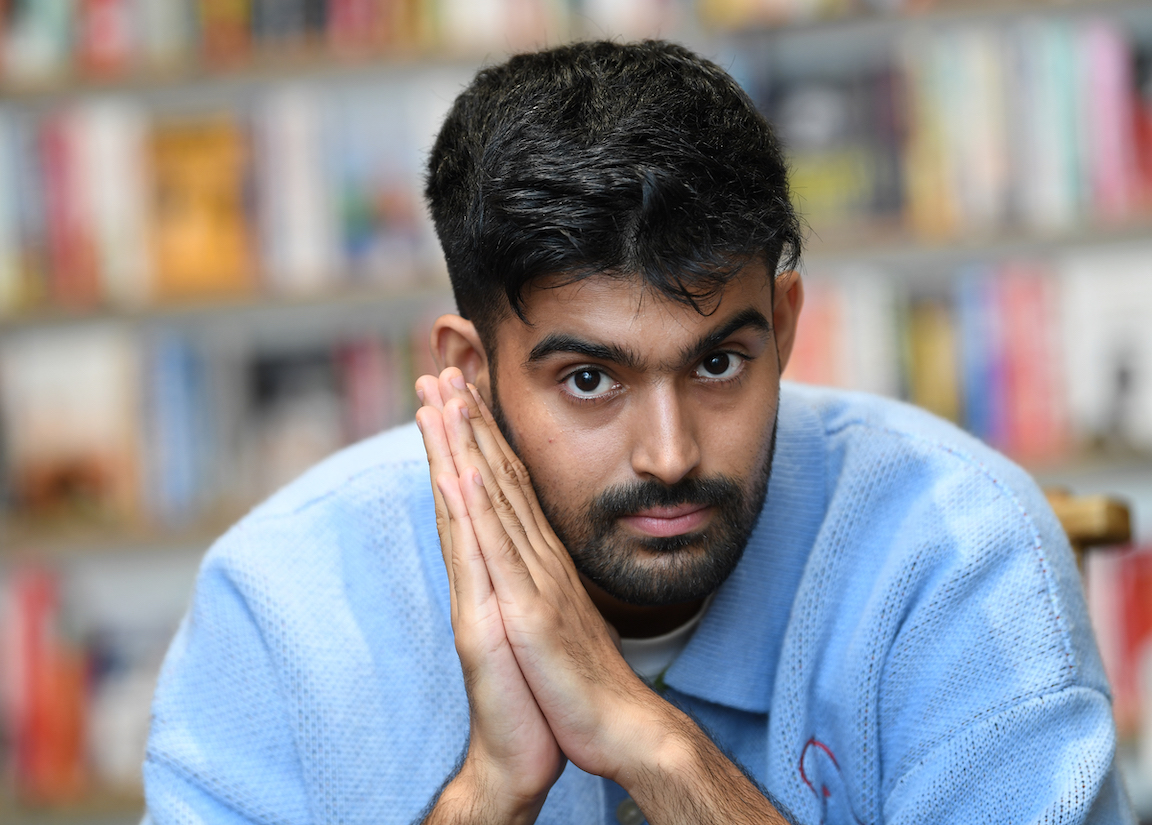
Sufiyaan Salam: Writing Himself into Blackburn Folklore
Few writers have captured the voice of young British Muslim life with the authenticity and humour of Sufiyaan Salam. In the space of a year, the Blackburn-born writer has celebrated a BAFTA nomination for his short film Magid / Zafar, won a British Independent Film Award and published his acclaimed debut novel, Wimmy Road Boyz. Yet behind the national recognition remains someone whose roots in Blackburn continue to shape every story he tells.
The first thing that strikes me about Sufiyaan Salam is not just his list of accolades, but the way his work opens new space for British Asian Muslim stories. He’s not simply a BAFTA-nominated filmmaker or one of Britain’s most exciting emerging novelists. He’s living proof that perspectives from the margins can, and should, shape the centre.
It’s that, despite everything that’s happened over the last year, the 28-year-old still feels unmistakably like someone from Blackburn.
Before we talk about Wimmy Road Boyz, BAFTA nominations or what’s next, we’re laughing about our old high school. As former Pleckgate pupils, the conversation quickly descends into gossip about teachers, familiar Blackburn faces and the kind of shared memories that instantly transport you back to your teenage years. Whatever success has brought him, it certainly hasn’t brought an ego.
He credits much of that to his parents.
“I can come home from a book tour and meeting celebs and still be expected to do the dishes.”
“My mum used to read me bedtime stories, that’s where my imagination started. Soon I wasn’t content with simply reading stories. I wanted to make them.”
For someone who has walked red carpets and is beginning to attract national attention, it’s a wonderfully ordinary image. Storytelling, it turns out, has always been there.
He remembers filming homemade movies with his cousin and proudly producing what he now affectionately calls a High School Musical rip-off back in 2009.
“I always thought creating things was fun. I started as an outsider. I had no industry connections. I just had ambition from the beginning to make a legitimate piece of work.”
Sufiyaan studied English Literature at the University of Manchester, where a tutor encouraged him to pursue writing.
Today, that persistence has been rewarded: a BAFTA nomination for Magid / Zafar, recognition at the British Independent Film Awards, and widespread praise for his debut novel, Wimmy Road Boyz.
Magid / Zafar is a critically acclaimed British short film that received a 2026 BAFTA nomination for Best British Short Film. Written by Suffiyan with Luís Hindman. The film follows two young British Muslim men who unexpectedly meet at a police station, where their conversations explore identity, masculinity, race, class and belonging in modern Britain. Through its powerful, character-driven storytelling, Magid / Zafar has earned widespread recognition on the UK film festival circuit.

Success, however, hasn’t earned him universal praise at home. When I ask what his family thought of Wimmy Road Boyz, he says, “My mum sent me a voice note saying it wasn’t for her. I took my dad as my plus one.”
After being caught off guard at the British Independent Film Awards, he decided to make a little more effort for the BAFTAs.
“I dressed up a bit more this time. It’s surreal. You’ve got Hollywood actors like Paul Mescal watching this Muslim British Pakistani film. As the clips from each nomination were played.”
Asked what the British Independent Film Award win felt like, he doesn’t offer a polished Hollywood answer.
“I blacked out when it was happening. I felt sick until it was announced.”
Despite a BIFA win and BAFTA nomination, Sufiyaan’s journey is defined less by the doors that opened than by the ones that didn’t. Even after national recognition, rejection remains part of the job.
“Magid / Zafar just got rejected from Manchester Festival after the BAFTA nomination. Not everyone is going to love your stuff. It doesn’t mean it’s bad. Self-criticism is good because it makes you better, but you’ve also got to believe in yourself.
“Gatekeepers are idiots.”
There is confidence in the way Sufiyaan speaks, but never arrogance. He seems remarkably comfortable with the idea that art isn’t supposed to please everyone.
That philosophy runs through Wimmy Road Boyz, already winning the prestigipous Merky books New Writers Pirze.
Inspired by a night out with friends, the novel follows a group of young British Muslim men as they navigate friendship, identity, and the often-absurd expectations placed upon them.

“I prefer to let the story do the talking. I let the book say what it needs to say.”
Instead, he talks enthusiastically about the characters.
“Immy was one of his favourite to write because “he was volatile and unpredictable”, while the Brown Cowboy gave him license to have a little more fun.
“The hardest part wasn’t writing entertaining characters. It was writing honest ones.
“You’ve got to write them honestly, even though they’re bad. I wanted to pack it with as many British Asian Muslim culturalisms as possible. Cultural heritage is cool.”
The more rooted his stories are in his own community, the more universal their resonance becomes. Despite involving himself in the arts and now living in the capital, he is deeply proud of where he is from, and who he is.
“Magid / Zafar specifically gave characters Muslim names, and Wimmy Road Boyz is about Muslim identity. I want it to be relatable, but the cultural specificity is the texture that makes it alive. It shows there are so many ways of being.”
Another theme woven through the novel is masculinity.
“I hope the readers come away recognising the absurdity of masculinity.”
The conversation inevitably turns back to Blackburn.
“It’s an interesting place. There’s such ambition in the people. It seems bigger than it is. The world is big even though it’s a small town.
“Growing up in Blackburn didn’t limit my ambitions. If anything, it sharpened them.”
Despite becoming the public face of increasingly successful projects, he insists the attention has never been the point.
“The book lives and dies with readers. You get to be the face, but I just like writing.
“I don’t make art because it’s something I selfishly enjoy. It’s fun, and I want to write for an audience that resonates with it. Beyond that, it doesn’t matter.”
Sufiyaan’s own work, he hopes, encourages more stories from communities that rarely see themselves reflected. His personal ambitions remain surprisingly modest.
“My goal is to buy a house. Professionally, though, a feature film is in development, television projects are taking shape, screenplays are being written, discussions continue around adapting Wimmy Road Boyz for the screen, and there’s every possibility of a second novel.”
Even the rise of artificial intelligence doesn’t seem to trouble him.
“Part of art is human expression; AI doesn’t understand human nature. We need nourishing work. We need to spend our time with stuff that matters.”
Before we finish, I ask him what continues to drive him after everything he’s achieved.
“I’m diligent and careful. I want to make something I’m proud of. I’m like Shakespeare and Jay-Z if he was brown.”
Leaving the conversation, I find myself thinking less about the BAFTA nomination than the person behind it. As we leave Pleckgate behind once again, it’s hard not to think about the students walking those same corridors today.
“Somewhere among them is another child making silly films with friends, scribbling stories in exercise books or quietly wondering whether a career in the arts is possible.”
Sufiyaan Salam is living proof that it is.